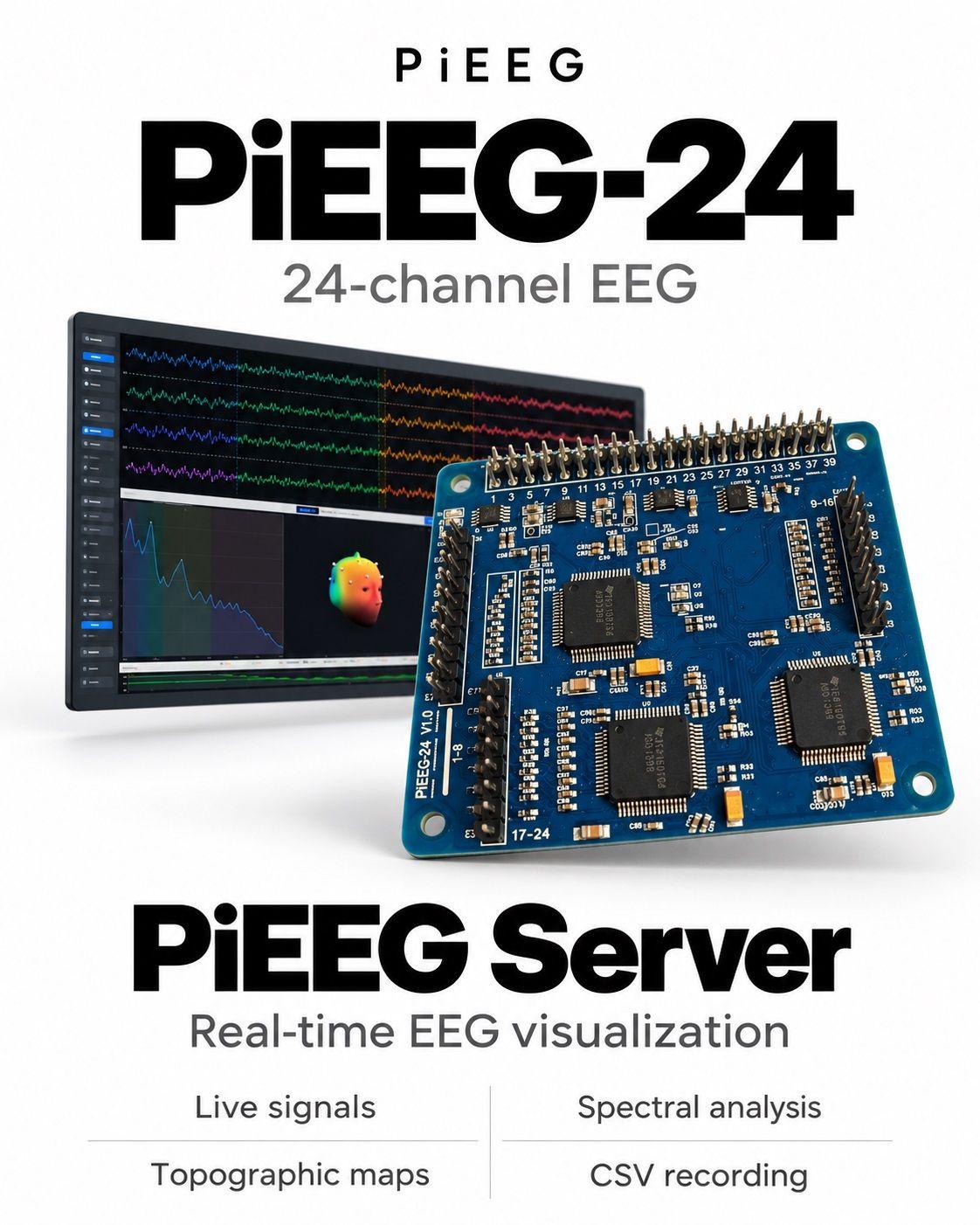
After an extended R&D cycle, PiEEG-24 is back in active bench validation—bringing 24 simultaneous EEG channels onto a single Raspberry Pi shield using dry electrodes and three Texas Instruments ADS1299 24-bit analog front-end chips.
Why Rust Acceleration Unlocked 24 Channels on the Edge
Scaling a Raspberry Pi shield from 8 or 16 channels up to 24 high-resolution channels multiplies both SPI read throughput and continuous multi-channel filtering load. To sustain deterministic real-time acquisition, bandpass/notch filtering, and spectral analysis without dropped samples on a single-board computer, we paired the triple-ADS1299 hardware stack with pieeg-core—our compiled Rust native accelerator inside PiEEG Server.
With zero-copy acquisition and compiled IIR filtering handling the hot path, a standard Raspberry Pi can now acquire, filter, visualize, and stream all 24 dry-electrode channels live.
Next Steps Toward Release
We are currently completing final signal-integrity checks, cross-chip synchronization verification, and open-source Python/Rust driver documentation in the PiEEG-24 GitHub repository ahead of hardware availability.