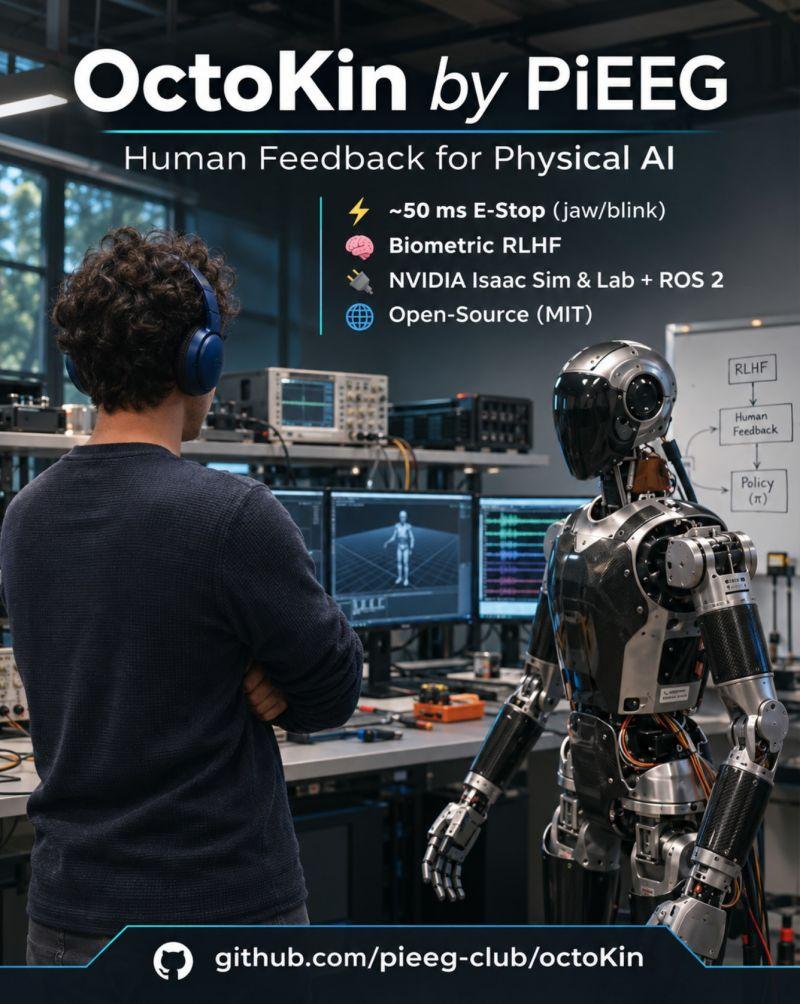
Modern robotic platforms can already perceive operators through cameras and microphones. With OctoKin—now released under the MIT license—robots and simulation environments can also respond directly to measurable physiological signals from the human body.
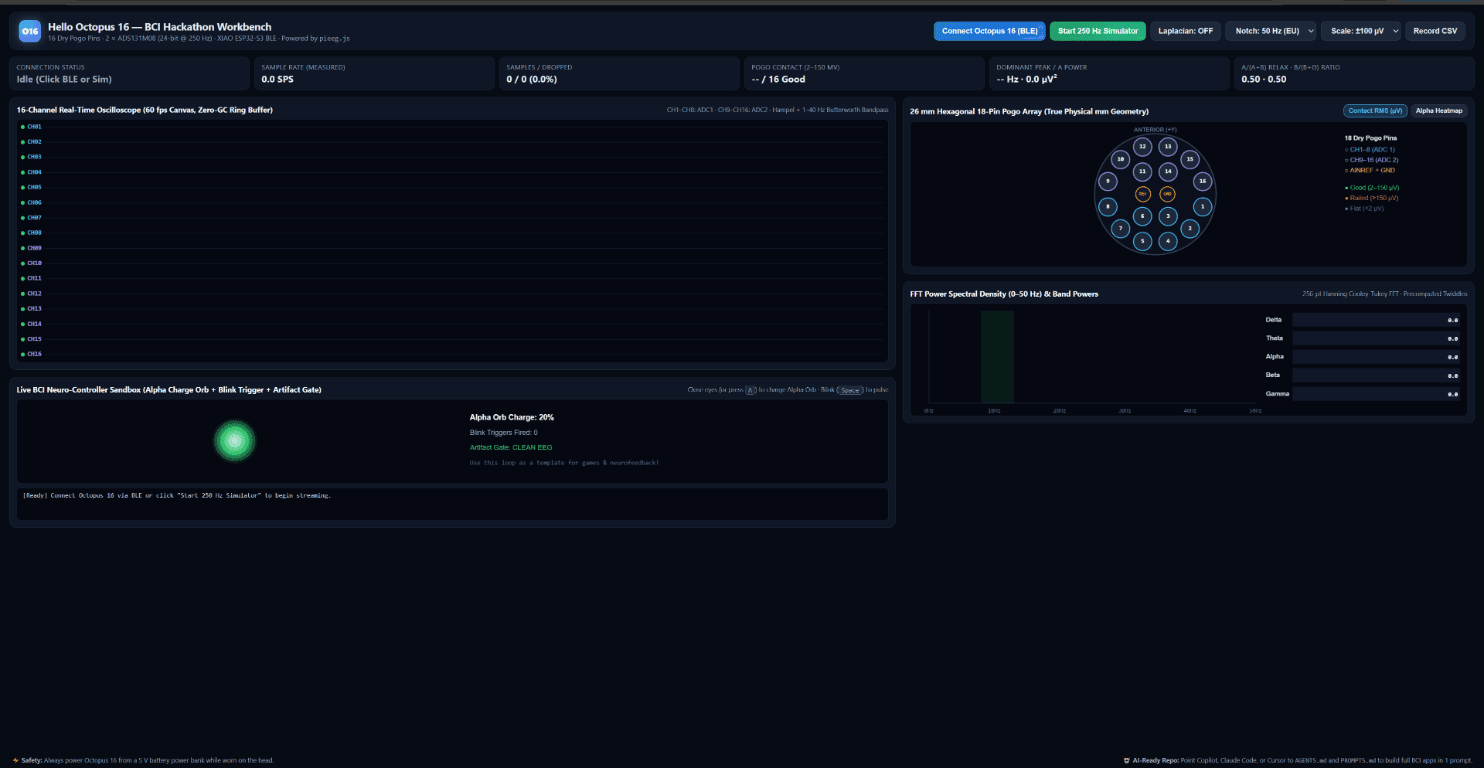
Built around our 26 mm, 16-channel dry-electrode Octopus-16 sensor, OctoKin streams live EEG, surface EMG, and EOG features into ROS 2, NVIDIA Isaac Sim, and reinforcement learning pipelines in Gymnasium and NVIDIA Isaac Lab.
Grounded in Measurable Physiology
OctoKin is designed strictly around explicit physiological triggers and continuous contact verification rather than black-box "mind-reading" claims:
- ~50 ms Physiological Safety Triggers: Voluntary jaw-clench EMG bursts (35–100 Hz) execute an immediate
/cmd_velhalt, while intentional double-blinks allow hands-free mode or waypoint switching. - 16-Pin Contact Quality Gate & Watchdog: Continuous scalp-contact monitoring across all 16 spring-loaded pogo pins—paired with a 500 ms telemetry watchdog—prevents loose electrodes or dropped BLE frames from driving erratic motion.
- Shared-Autonomy Modulation: Real-time Welch spectral band ratios (
alpha_ratioandengagement_index) smoothly scale robot velocity or compliance within operator-defined safety bounds. - Biometric RLHF for Isaac Lab: A drop-in
HumanFeedbackWrapper(env)aligns 250 SPS physiological state streams and explicit preference labels (+1 / -1) with 50–100 Hz policy steps, automatically gating out noisy frames during human-in-the-loop training.
Native ROS 2 & Container Integration
Instead of requiring custom C++ message definitions, OctoKin publishes standard geometry_msgs/Twist, std_msgs/Float32, and std_msgs/Bool topics (/octokin/signal_quality, /octokin/intervention, /octokin/speed_scale, and gated /cmd_vel). That makes it immediately compatible with NVIDIA Isaac Sim's omni.isaac.ros2_bridge, Nav2, MoveIt Servo, and Unitree ROS 2 stacks, as well as Docker and WSL2 setups via a lightweight UDP host bridge.
Test the Pipeline Without Hardware
Researchers and robotics engineers can evaluate the entire ROS 2 and reinforcement learning workflow immediately using OctoKin's built-in synthetic signal generator:
git clone https://github.com/pieeg-club/octoKin.git
cd octoKin
pip install -e ".[dev]"

octokin check --source demo --duration 5
python examples/isaac_sim_controller.py --source demo --duration 11 --fast
python examples/rl_human_feedback_demo.py
Safety note: Octopus-16 is a non-medical research sensor without galvanic isolation and must only be powered from an isolated 5 V USB battery bank (≤ 2 A) while worn.
Explore OctoKin
- GitHub Repository (MIT): github.com/pieeg-club/octoKin
- Hardware Platform: PiEEG Octopus-16