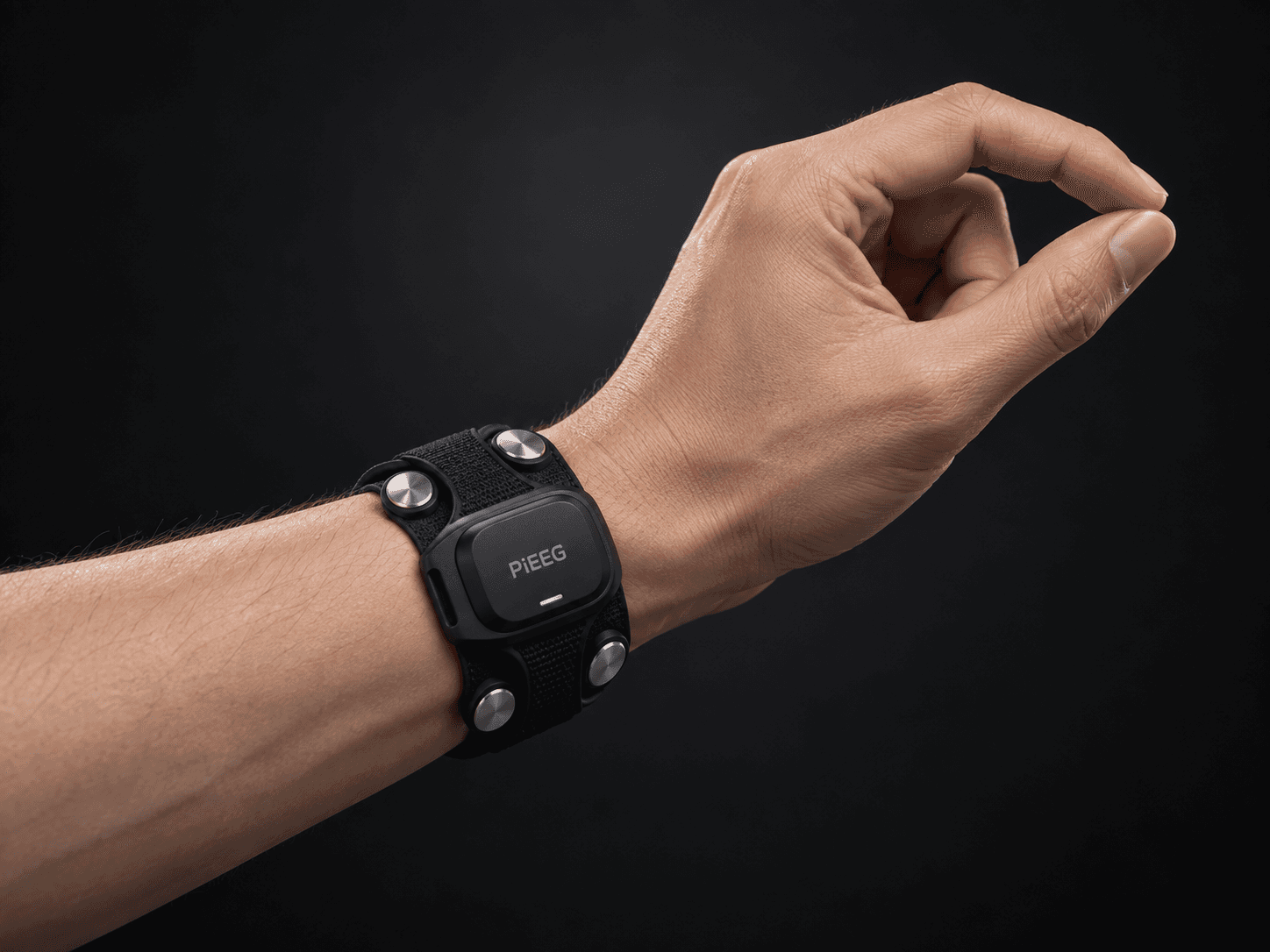
octoBridge is a classroom lab that runs in the browser. Wear Octopus-16. Plug the octoBridge board. The same tab reads both, then moves a light, a servo, or a screen.
Open it at octobridge.pieeg.com.
Two devices, one tab
Octopus-16 is the scalp side: 16 channels over Bluetooth. The tab computes the reading. Hampel, a band-pass, then an FFT. What comes out is relative band power, an RMS in µV, and two indices labelled focus and relax. Those indices are uncalibrated. A blink or a jaw clench raises RMS. That is muscle, not a thought.
octoBridge is the room side: an Arduino Uno (ATmega328P) over USB. It reports light in lux, distance in centimetres (a facing surface is required), temperature, and humidity. Moisture, sound, and the knob are raw counts from 0 to 1023. It also reports a button, PIR motion, IR remote codes, and 6-axis tilt. Tilt is gravity. There is no magnetometer, so there is no heading.
Outputs are two lights, a relay, a buzzer, a servo from 0 to 180 degrees, and a 16×2 character screen.
Web Serial and Web Bluetooth stay in this browser. Chrome or Edge, on https or localhost. Nothing is installed.
Flash once. Then the page is the program.
The first visit puts firmware on from the tab. Octopus-16 flashes the XIAO ESP32-S3. octoBridge takes a hex through the Uno bootloader. No Arduino IDE, and no second sketch later.
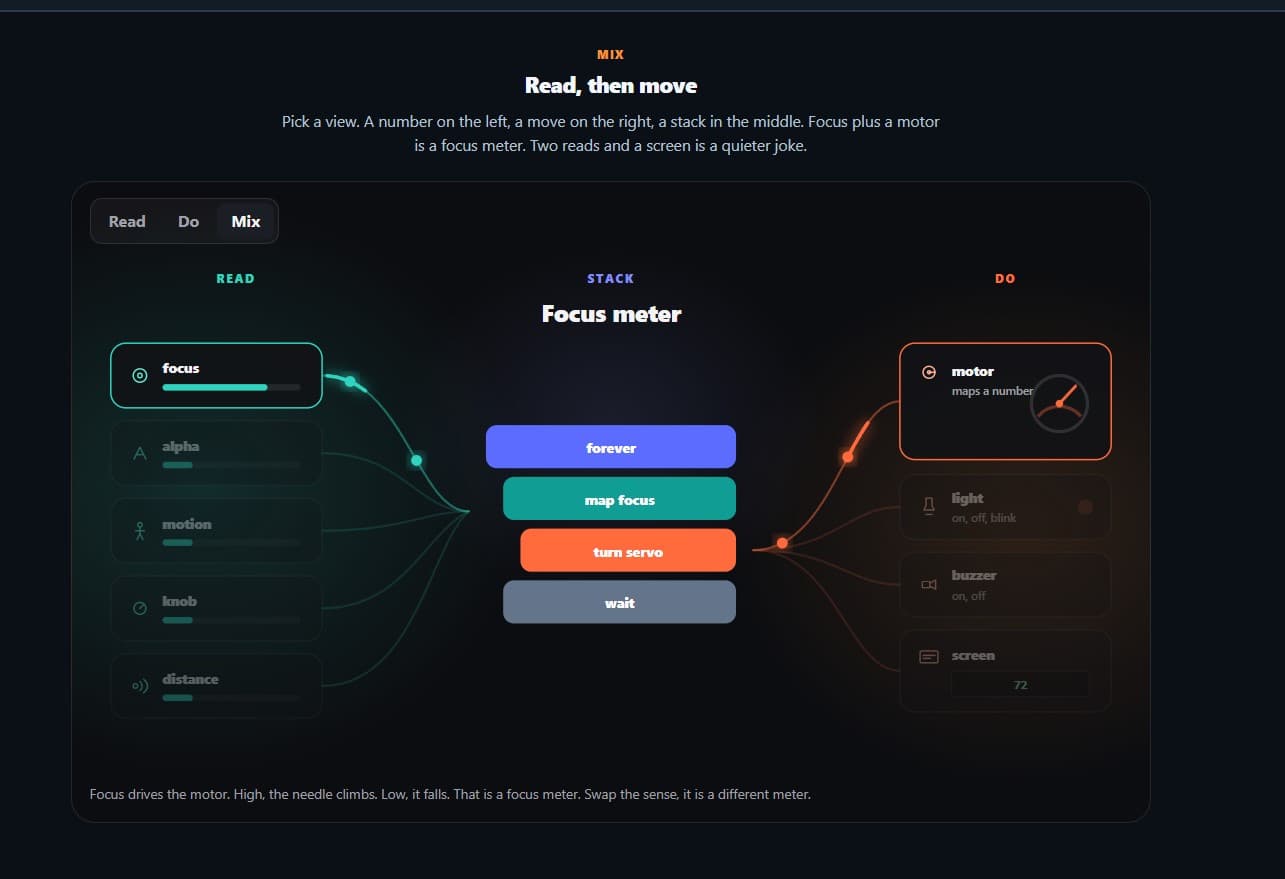
After that, Board shows live numbers and lets you press a light, turn the servo, or write the screen. Blocks stacks forever, if, wait, and a move. Write is the same run, typed as sentences: a comma waits a moment, a period waits longer. Repeat runs six ready machines and does not overwrite the stack you wrote. Learn reads the same fields and does not send commands.
A stack sends the same serial commands as the Board studio. It does not flash a new sketch.
What you can actually build
Close your eyes, alpha rises, a light comes on. Map focus onto the servo and the needle follows an uncalibrated index, scaled onto 0 to 180 degrees. A walk-by on the PIR turns the buzzer on. Moisture is still a raw count: when it drops, the relay can switch a pump. Two reads can share one action. High alpha and no motion can write a line on the screen.
Swap the sense and you have a different meter. The pieces do not change.
Limits
This is a classroom tool. It is not a hospital test.
- Focus and relax are uncalibrated indices.
- Sound, moisture, and the knob are ADC counts, not calibrated units.
- Distance needs a facing surface. A missed echo is not "very far".
- Blink and jaw are not thoughts.
- Safari and phones cannot open USB serial.