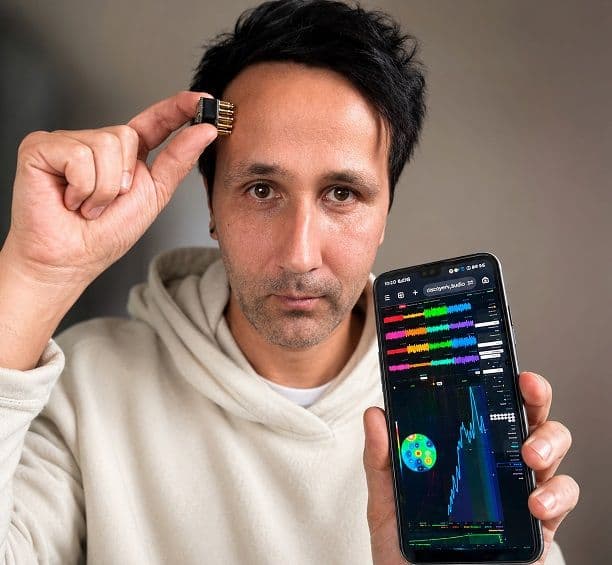
Imagine a medical-grade brain monitoring device that fits in your pocket. Not someday—we're testing it right now.
The Digital Stethoscope for Your Brain
We've built a 16-channel EEG device the size of a coin. It streams neural data wirelessly via Bluetooth Low Energy directly to your mobile phone, where the PiEEG Server processes everything in real-time.
This isn't a prototype concept or a funding pitch—it's hardware in active testing.
Why This Changes Things
16 full EEG channels in a form factor that disappears. Traditional EEG caps are bulky, wired, and confined to labs. Even "portable" systems require dedicated hardware and careful setup.
This device flips that model: high-resolution dry electrodes that work without conductive gel, wireless connectivity that pairs like any Bluetooth device, and processing that happens on the phone you already carry.
No gel. No lab. No limits.
Testing in Progress
We're in the early testing phase, and the possibilities are wide open. The question isn't "does it work?"—we're seeing clean 16-channel data already. The real question is: what do we build with it?
Real-time neurofeedback apps? The low latency and mobile-first design make responsive feedback loops possible outside clinical settings.
Long-term cognitive tracking? The form factor enables continuous monitoring scenarios that current hardware makes impractical.
Spatial BCI applications? Combine 16-channel spatial resolution with AR/VR headsets for next-generation brain-computer interfaces.
See It In Action
We've documented the current testing phase, showing real 16-channel data capture and the mobile workflow in practice.
Explore the Dataset on GitHub →
Join the Conversation
This hardware is part of a larger shift in how we think about accessible neuroscience. We're building in public with a community of over 1,000 researchers, developers, and BCI enthusiasts.
What would you build with pocket-sized 16-channel EEG? The hardware is taking shape—now we're figuring out what comes next.